
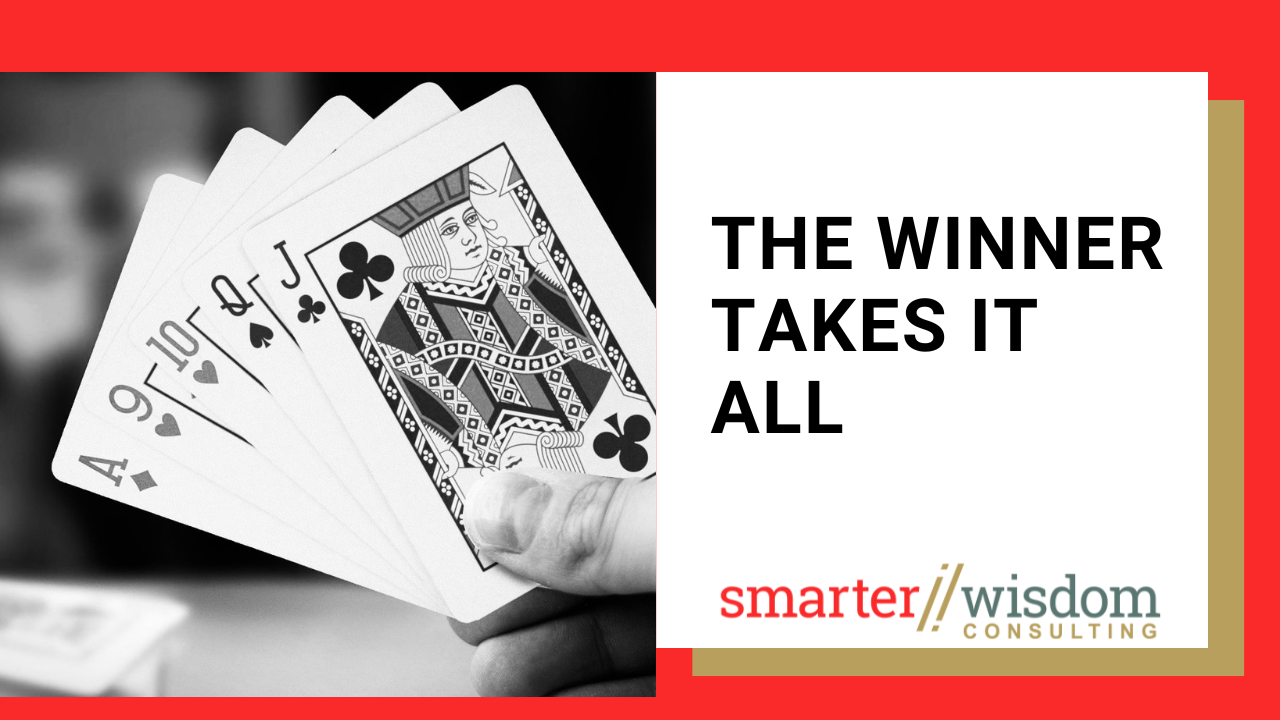
The Winner Takes It All
As readers of Words of Wisdom have surely observed, I like win-win arrangements. At their core, they are self-managing, since everyone needed to make the solution work is also invested in reaping its benefits. The result itself has built-in motivation, since all participants are motivated for success. Really solid win-wins are self-fueling, so they don’t need continual monitoring, pressure applied from the outside or a pipeline of external energy to keep them running for a while. These are the reasons why I love the concept so much!
A quandary that I frequently observe, however, in my work on both the people and the strategy side of organizations, is a pattern of missed opportunities. My clients range from organizations with a highly successful history behind them, to earlier-staged entities, and everything in between, but their leaders have a shared intent behind the engagement: to ensure their workforce delivers the critical components of success. Their employees are, generally, motivated professionals trying to do the right things to help make their enterprise achieve its goals. In addition, quite a few of the leaders throughout the ranks make a point of being aware of the latest trends and approaches to developing their people and their structures; this is evidenced by their efforts to work in the realm of best practice and their continual professional development through conference attendance, and attending to relevant pod-casts, blogs, articles and books.
I love these qualities in my clients; both organizationally and through their individual employees, the intent is positive and that zeal could result in real contagion (in the best possible sense!). But when I spot missed opportunities, they lead me to wonder why and how that happens so regularly.
Last month I had the pleasure of introducing Jenny Dearborn, business executive and author, at a meeting of the Human Resources Leadership Forum. Her findings were compelling and they made good sense. It was evident that in the course of her leadership in the chief people role in multiple highly successful organizations, she had leveraged both her insight and chops to see the way forward for her companies and successfully implement high value ideas.
With that track record validated and displayed in her presentation, she did not imply that every effort HR had made under her tenure, in a CHRO role, was successful. But she did produce a better-than-average list of accomplishments, and that inspired me to reflect a bit on her latest area of focus: Transforming Workforce Analytics to Organizational Value.
My own research examines why and how some individuals rise to the top of organizations. Integrating those findings with my new knowledge about Dearborn and other similarly successful individuals, it became clear that there are approaches they have in common, for example: many clever, insightful & executable ideas (and they do not pursue them all); constant curation of their list; no attachment to initial insights. Even though the selection criteria varies among these talented individuals, they always turn to specific qualifying criteria to keep ideas on the list. Each of them always includes data-driven support.
A typical set of questions they might use to see if the proposed concept might move forward would be:
How much of an impact would it have on our organization’s most important goals?
Is there a way to successfully execute this idea? What are the initiatives and steps required to bring it to fruition?
Can individuals be identified who could champion this effort strategically and functionally? Who would its organizational allies be?
What is the value proposition in this idea? Given what will be required to sell, implement and leverage its outcomes, how do the end products of the initiative stack up in a cost/benefit analysis to our organization?
If this idea moves forward successfully, the promoter will have achieved their goals, but the organization will have foregone pursuing others. Will it be worth the investment?
Executives who are good at winnowing understand that it is a process, not a one-time decision. If you are seeking to become one of those leaders, DO NOT toss out the questions for consideration after you hit the GO button. It is guaranteed that you will become more invested in the initiative as it moves through the steps of conception, consideration and execution—but continue be tough on your idea.
Figure out what will make you flip the OFF switch. And review that off ramp regularly. There are guaranteed junctures of reconsideration for even the best ideas. Certainly be prepared to shut it down if the cost of the pursuit outweighs its ultimate benefits. As Kenny Rogers eloquently put it, “You gotta know when to hold ‘em, know when to fold ‘em.” Because what you don’t want to do is have a great idea take you down by revealing its goal to have been, well, kind of incidental. And remember win-win is the desired goal, something for everyone in the game.
ADDITIONAL BLOGS THAT COULD BE OF INTEREST




![Five Years of [Smarter] Wisdom](https://images.squarespace-cdn.com/content/v1/5df3d7e1dbbe8324bca69b9e/1736284643919-HQTJWWCL93I95RYINF5D/5+years--use.png)


