
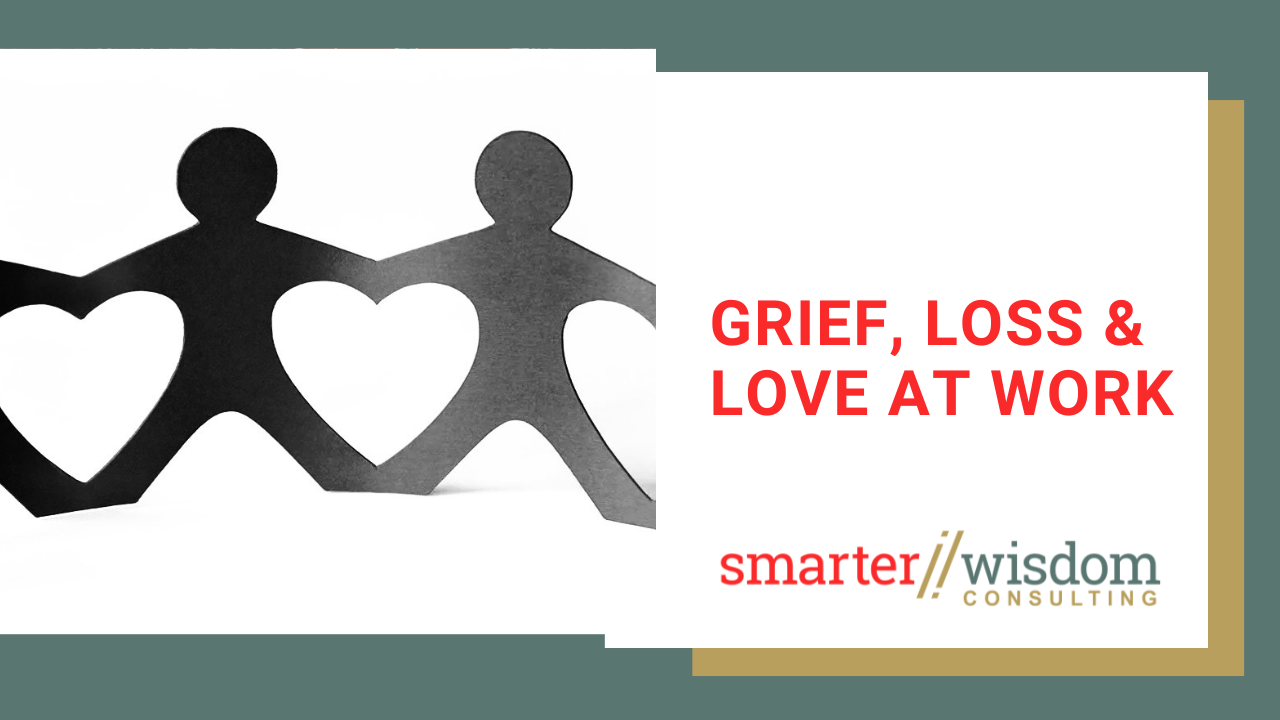
Love, Grief and Loss at Work
In my work with non-profit leaders I know that we can never spend too much time on mission—since it is truly at the core of everything we do and need to pay attention to. I find that most of our conversations can either flow from mission, or mission-related matters, or we quickly pause and ask the question: how does this relate to the mission? Leading a mission-driven entity is a great honor, frequently the perfect place to develop both our focus on being a servant leader and also understanding more deeply our purpose and the purpose of our colleagues. We are, however, unless we lead a faith-based organization, neither preachers nor counselors: we are chief executive officers with the success of our organization as our core goal.
So what do we do with emotion, feelings and human connections? And can we, should we, and how might we, truly and successfully harness and incorporate the relational aspect of our lives and the experiences of those whom we serve into the ethos of our place of work, both organically and generatively?
The work of the executive director is often to name things, to describe and state what is happening and create a narrative that is helpful and can hold the community together. As we tell and retell these stories that help our cultures form and grow strongly, asking questions about the unique nature of mission-driven organizations and integrating consciously all that makes us human (grief, loss and love to name three) is vital.
Recently I was reading about change and loss—how leaders have to see that frequently what comes across as fear of change might in fact be fear of loss. Loss of any kind, from a favorite pair of socks that fall into threads to the loss that brings grief when a friend or relative dies, brings sadness, a sense of missing something irreplaceable, a feeling that part of us is gone. And while organizations cannot bring in grief counselors each time a new business structure or technology replaces an old one, leaders can factor in that saying goodbye to something does take energy and time, and simply acknowledging that might be worthwhile.
How hard is it to integrate emotion and feelings into our work as leaders? So much of the conventional wisdom around leadership is about maintaining composure, projecting confidence, staying “objective” — all of which can quietly train leaders to wall off exactly the emotional intelligence that makes them most effective, especially in mission-driven settings. I can certainly remember in my early days as a leader that I needed to tread carefully when it came to emotions and to watch, in particular, how I might deal with human relational issues. That arc of a leader learning to trust feelings as data, not distraction, is an important growth trajectory. The internal pressure leaders feel not to be “too emotional,” to stay professional, to move on, is strong and easily prevails. It certainly behooves us all as leaders to look back to when we were able to do the opposite— acknowledge what we saw (and hopefully felt), not fear it, integrate the feelings and awareness of them into our work to help us move forward with that knowledge. That is the data and awareness that will help make the situation better. Consider what helped us do that —what part of us changed and grew to allow us to show empathy?
Arguably, these days we have no choice but to move away from the distant leadership approach. The big changes in work that happened during the pandemic have become fully integrated into our post-pandemic world. We know more about each other; we have connected with each in ways that were not typical 10 years ago. We know more about people’s families, their fears, and what their kitchens (and sometimes even their bedrooms) look like, as our colleagues set up their home video nooks. The ease with which social media connects us and reveals facts about us is a blessing and a curse–and also means that the relational is rapidly inserted into our daily work.
It is obvious when a beloved colleague leaves a nonprofit or school, there is sadness. What the community is actually mourning is perhaps the particular expression of love that person brought to the work — the specific way they made others feel seen, the energy they added to the mission. That’s not replaceable in any generic way. And this kind of loss needs to be acknowledged and integrated somehow into our community. In addition, lack of this acknowledgement could signal something negative about other kinds of loss or change that will undoubtedly affect our places of work.
As I write this piece Marcus Buckingham’s book Design Love In: How to Unleash the Most Powerful Force in Business is newly in print. From early reviews of this book, Buckingham’s framework would suggest that leaders who fail to name and honor loss are, in effect, “designing love out” at precisely the moment it needs to be the most visible. In the introduction to the book, Buckingham describes the tremendous loss he felt as a leader when he sold his firm, not realizing the devastating effect it would have on his employees—and ultimately on him. All indications from reviews of his book, and my early reading, indicate that he now knows fully that the power of love and a deeper understanding of relationships and connections truly need to be an integral element of successful organizations.
Embracing the new norms of the workplace and the ways in which our work and our lives are integrally connected mean that we need to see even more the shared and vital experience of everyone drawn to our mission-driven enterprise. Buckingham’s book is about the corporate world and because of that his arguments only highlight even further what non-profits can already do: integrate emotion as we build the experience of members of our community. Fully articulating the power of grief, love and loss in our organizations is an act of positive leadership; naming the relational experience as core to our success as leaders broadens the continuum of mission-driven organizations and perhaps signals to the for-profit world that accepting the power of understanding and implementing more of a focus on love, grief and loss will benefit us all.
ADDITIONAL BLOGS THAT COULD BE OF INTEREST







![Five Years of [Smarter] Wisdom](https://images.squarespace-cdn.com/content/v1/5df3d7e1dbbe8324bca69b9e/1736284643919-HQTJWWCL93I95RYINF5D/5+years--use.png)


