
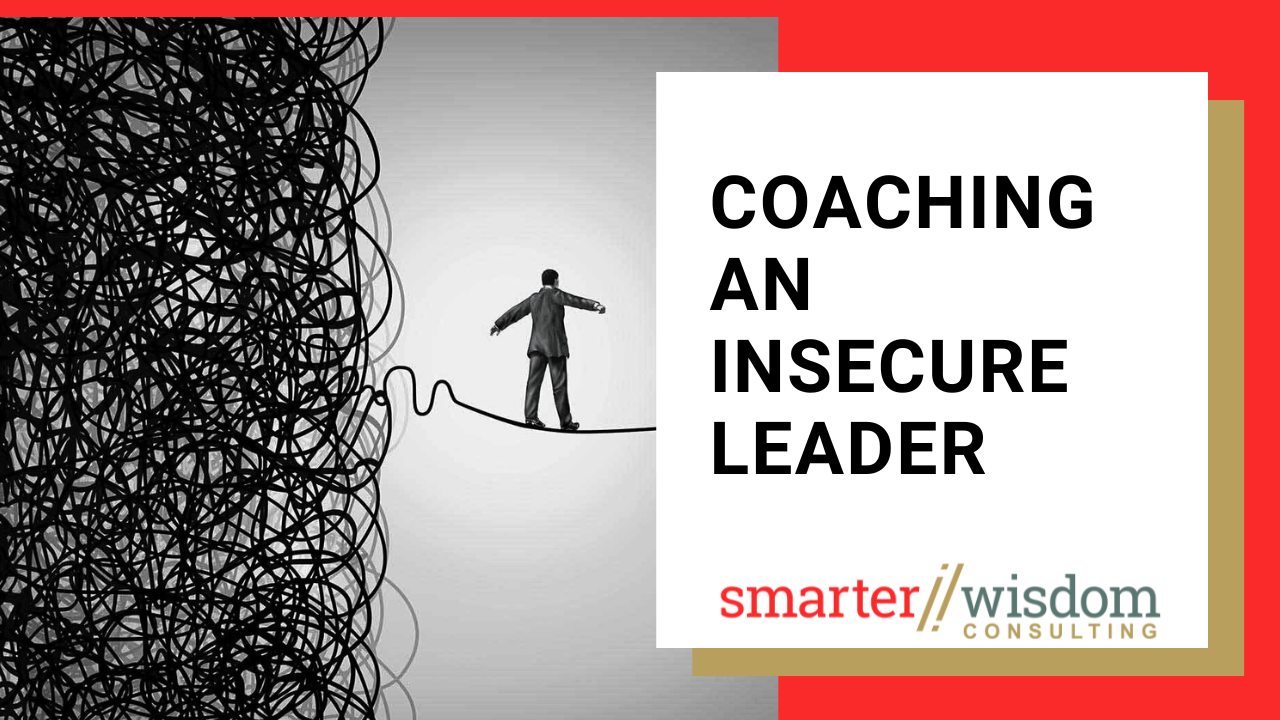
Coaching an Insecure Leader
SmarterWisdom has written a lot over the years about the foundational needs for a leader to become better at what they do: self-awareness, a growth mindset, the willingness to take feedback, holding themselves and others accountable, building and practicing trust of their team, treating people with respect and listening well, just to name a few. What about those insecure, or less confident leaders who lack these skills and who in fact might have a list of opposite traits which impede their own growth and the growth of their organization? We work with all kinds of leaders and for sure it is those that lack confidence in themselves, knowingly or not, that present with a tough challenge, even for SmarterWisdom!
So how do we partner effectively with these types? And is it possible that they may overcome some of their tendencies towards insecurity, and, as needed, develop more self-awareness that might set them on a path towards further growth?
We have created a couple of composite profiles for you to consider with us.
Profile One: Steve is a relatively new executive director in a small non-profit serving the social sectors. He has an impressive pedigree: graduate degree in executive management, 12 years of experience reporting directly to heads of organizations and a reputation for being a strong no-nonsense kind of person. Jane began working with Steve about 8 months into his new role. He had begun to wonder if he could manage this new senior leadership role, especially as he had begun to hear rumblings of criticism from his direct reports and from one senior colleague, whom he trusted. He sought out a coach to partner with.
Profile Two: Maeve, after a decade of experience in the calendar/bookings offices at two small colleges, had been hired two years before as director of calendar and events at a larger research university, replacing the well-regarded director who had just left after 12 years in the role. Marcie became involved when Maeve’s new boss called to express his concern that she did not seem on top of her responsibilities and perhaps not reaching the potential he had hoped for.
In working with Steve, Jane soon identified his tendency to struggle mightily when his approach was not working. He quickly became frustrated and moved into micro-managing the situation, rather than finding a way to step back and see the bigger picture. Telling people what to do, with little back-and-forth, seemed to be his go-to style. Questioning his team members’ skills and approaches was common. When he had difficulty with staff members, he struggled to use a growth mindset but rather simply listed out the changes they needed to make. “My way or the highway” is an apt phrase to use when thinking of Steve’s approach. Jane tends to use role play in her meetings with Steve, short played-out examples where she and Steve exchange roles and then analyze what happened and what might have happened, with some different approaches. Steve does not see himself as insecure and he clearly possesses significant leadership strengths. In a typical exchange between Jane and Steve, Jane asks him to run through his initial intentions for a meeting and then they analyze together what happened and how it met his goals. The conversation might shift to what did he do or say that he might replicate in a similar conversation. In addition, once he seemed more aware of the issue at hand, was there a way for him to follow up.
After further conversations, between Maeve and Marcie, Maeve expressed willingness to work with her, and saw the match as a good one. Marcie quickly learned that Maeve felt as if she hadn’t really assumed leadership of her team and that she was failing at producing the level of income for the school that her predecessor had delivered. From their early meetings, it was clear that Maeve had a developed sense of self awareness.
With Marcie’s guidance, she and Maeve agreed that Marcie would speak to some of Maeve’s staff members and selected colleagues. Marcie would observe Maeve at meetings and meet with these colleagues individually. These interviews confirmed much of what Maeve had been feeling: that she had not yet taken hold as a leader in this new setting.
The path to Maeve’s gaining confidence lay in her coach helping her better understand the challenge, specifically, what was standing in the way of success, and that she actually had the capabilities to achieve it. By affirming that Maeve was on point in her belief that she was not getting what she needed from others to succeed, Marcie was then able to work with her to understand why that was happening and what she could do to turn her situation around. Unlike Steve, who was less aware of his insecurity, Maeve was hyper-aware that things were not working: she simply did not have an understanding of what to do to reverse the situation. Marcie’s step-by-step approach, building trust and creating a strong partnership helped her become more confident in her ability to find ways to improve this situation. Like Steve, she had been highly successful in her earlier positions, so this was a new situation for both of them.
In both cases, Jane and Marcie asked their clients about times in their earlier careers when they had felt successful. They looked at where and why they had been effective and identified patterns that demonstrated where their strengths lay. Finding their confidence and building on their strengths began to create a new foundation for success. In some ways, the work was easier for Maeve, who held a level of self-awareness that helped her stay open to growth. Steve, on the other hand, tended to continue to use the same approaches that were rarely successful in this new setting. Again, in both cases though, our clients held a deep belief that things could be better; they could in fact experience more success and leaning into their strengths would serve them well.
Coaching was vital in both these cases. Developing a relatively long-term coaching relationship gives Steve and Maeve a safe place to try out ideas and to build a strong thinking partnership that allows for productive back and forth. Neither of these situations can be solved with a quick fix; they are both about long-term professional growth and development. Both these professionals had to commit to continuing this work and letting their supervisors and their teams know that this was a priority for them, In Maeve’s case, it helped her to reframe her understanding of who she was, what she could do and how to be her best self in her latest role. Creating a foundation to “break the chain” through strengthening her confidence and to help her through the stages of executing a solid strategy resulting in recognized wins, was unlikely to have occurred without external intervention. In Steve’s case, he began to see there were different ways of doing things. Joining a peer group of non-profit leaders, for example, gave him collegial feedback that felt safe and helpful to him.
In our time working with less secure leaders, we attempt to discover how much the lack of confidence or insecurity is affecting those around them—their immediate reports, their team members and their immediate supervisor. Hence Marcie’s use of interviews and/or a “360” kind of approach. A key part of coaching leaders with less confidence is determining how self-aware they are, along with how much they might be able to grow within their current work environment. Steve and Maeve provide us with two helpful types to consider, and as you see, there are many layers to the work they need to take on. These efforts are crucial, and life-changing and SmarterWisdom believes they are at the center of healthy and sustainable leadership growth.
ADDITIONAL BLOGS THAT COULD BE OF INTEREST





![Five Years of [Smarter] Wisdom](https://images.squarespace-cdn.com/content/v1/5df3d7e1dbbe8324bca69b9e/1736284643919-HQTJWWCL93I95RYINF5D/5+years--use.png)


