
Getting Out Front — Why the Higher You Climb, the More You Need to Look Outward
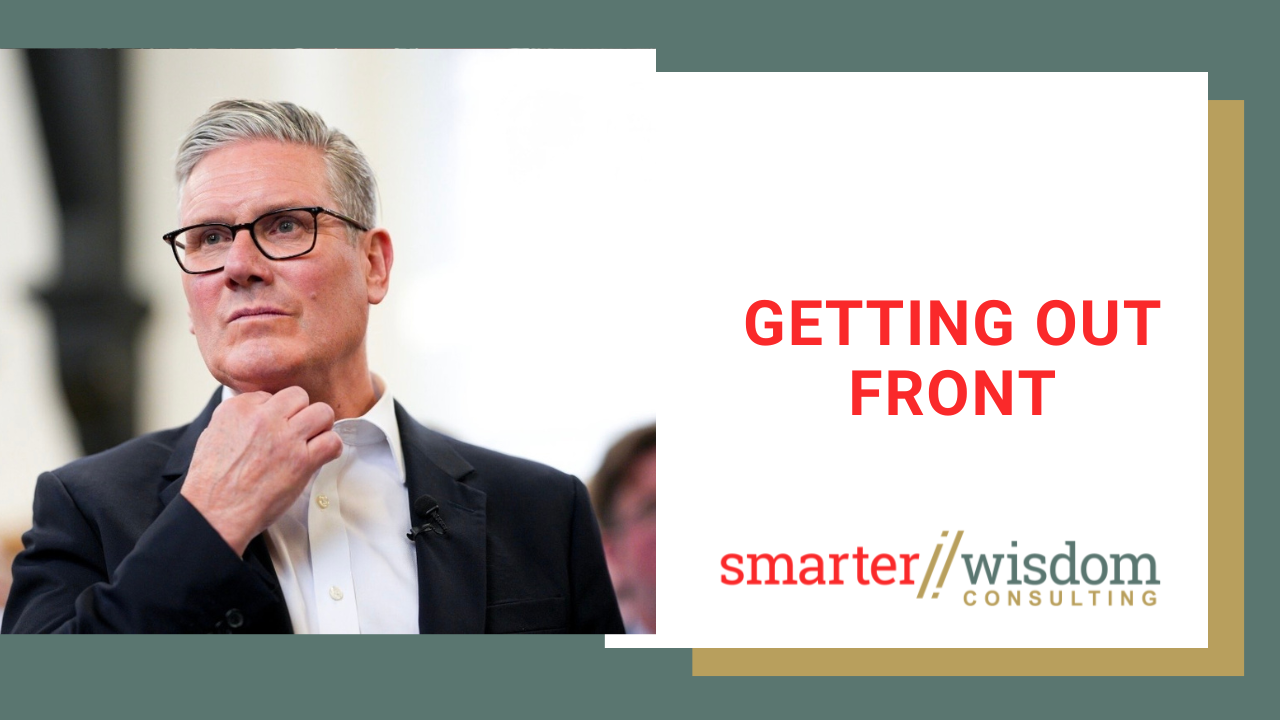
A few weeks ago, on June 22, British Prime Minister Sir Keir Starmer announced his resignation—less than two years after winning a landslide election. What struck many observers wasn’t the fall itself, but the speed of it, and the degree to which Starmer appeared, in his final weeks, to have lost the thread of connection to his own party, his voters, and the shifting political ground beneath him. In his own words: “The question my party is asking now is whether I am best placed to lead us into the next general election. I have heard the answer….”
He heard the answer — but perhaps too late.
Whatever one’s politics, the Starmer story is a vivid illustration of something that plays out in organizations of every kind, at every level: the higher you rise, the harder it becomes to stay genuinely connected. And the more costly it is when you don’t.
The Paradox at the Top
There’s a dangerous irony built into senior leadership. The stakes get higher. The decisions get weightier. The need for good information, strong relationships, and clear situational awareness grows. The irony is that it is precisely at this moment, when you are closer to the top, that the conditions that support those vital necessities begin to erode.
Research confirms what many leaders feel but rarely name or even seem aware of. More than half half of CEOs report experiencing genuine isolation, with a significant majority (61%) attributing declines in their performance directly to it. Senior leaders in fact experience higher levels of loneliness than employees at any other level of the organization. The causes of this isolation are actually structural, not personal: the pool of true peers shrinks as you rise; teams, however well-meaning, begin to filter what they bring to you; confidentiality and the weight of responsibility create emotional distance. Despite the busy nature of the work, which would seem to ensure that constant relationship building and feeding are on tap, it is lonely at the top.
As one body of research puts it, isolation in leadership rarely announces itself. It builds slowly, quietly, showing up in a calendar packed with meetings and empty of genuine connection.
On the one hand, the higher you climb, the harder the fall; and on the other, the higher you climb, the more invisible the ground beneath you can become.
What Gets Lost When Leaders Look Over Their Shoulders
When isolation takes hold—or when the anxiety of high-stakes leadership turns inward—leaders tend to shift into a defensive position. They become reactive rather than generative. They manage risk rather than scan for possibility. They protect what they have rather than build toward what’s next.
This is understandable. But it can be costly.
The leaders who navigate complexity most effectively tend to share a different orientation. They stay outward-facing even when the pressure to hunker down is greatest. They invest in relationships before they need them. They maintain visibility in their professional communities not as a strategy but as a practice. They stay curious about what’s emerging in their fields, who the interesting thinkers are, what doors might be opening.
In short: they keep looking forward. Not over their shoulders; staying ahead of the game.
A Story Worth Telling
I think of a leader I know, a head of school who, throughout her tenure, made a quiet but consistent habit of staying connected. She showed up at conferences not just to represent her school, but also to engage genuinely with the ideas and the people. She cultivated relationships with peers at other institutions. She stayed interested in what was happening in the broader world of education. She found opportunities to broadcast her achievements, in a natural but explicit manner. She knew her own strengths, and that knowledge gave her a kind of groundedness that meant she didn’t need to scan the horizon for threats—she could scan it for possibilities instead.
When her time at that school came to an end, she didn’t experience the jarring disconnection that many leaders feel at such transitions. She had a network, not a transactional list of contacts, but a genuine web of relationships built over years of authentic engagement. Those relationships had supported her during her work. They became her web of connection to the future when she needed to move to her next challenge.
That, I’d argue, is what getting out front actually looks like. Not recklessness. Not self-promotion, rather a rock-solid forward-leaning focus on the broader landscape. She managed to build and sustain this view even when the daily demands of leadership made it feel like a luxury.
Why This Is Harder Than It Sounds
Research on executive networking confirms a paradox that deserves naming: senior leaders have less time for relationship-building when their networks matter most; and those who are able to develop and maintain these relationships, truly are able to get out front and direct their own course.
Time is the obvious constraint. But there are subtler ones. Ego-driven reluctance—the discomfort of being the one seeking connection and insight rather than the one dispensing it—can quietly calcify at senior levels. Cultural expectations in many organizations treat a leader’s vulnerability or outward orientation as a sign of distraction or weakness. Frequently teams, trying to protect their leaders, often become inadvertent gatekeepers, shielding them from the honest feedback and outside perspectives they most need.
The result, for many leaders, is a gradual narrowing of information, of perspective, and of possibility. Sadly, they often don’t notice it happening until the narrowing has already done its damage.
What Staying Out Front Actually Requires
None of this requires a radical reorientation. It requires intention, practiced consistently. It means building and tending relationships when you don’t need anything, so that when you do, they’re already there. It means staying engaged with professional communities, networks, and conversations beyond the walls of your own organization. It means cultivating enough self-knowledge to have a secure sense of your own strengths — because leaders who know what they bring to the table can afford to be curious and open rather than guarded and defensive.
In addition, strong senior leaders do well to develop a tolerance for not-knowing: a willingness to look at the broader landscape with genuine interest rather than anxious surveillance. The difference between scanning for threats and scanning for possibilities is largely a matter of internal intent. The practical effects on a leader’s life and career are, however, enormous.
A Final Thought
Keir Starmer is a serious, capable person who dedicated himself to public service. His story is a cautionary tale that serves to illuminate something real: that the position of leadership can create the very conditions—isolation, filtered information, narrowed perspective—that undermine the judgment leaders most need to exercise.
The antidote, while available, is not especially easy to implement. It looks like a head of school who kept showing up, stayed connected, and arrived at the next chapter of her career with relationships and possibilities already in hand. It looks like a leader who, even under pressure, kept her face turned toward the horizon.
That’s what getting out front means. Not outrunning the hard things, just refusing to let them turn you inward.
NOTES:
Written with the assistance of Claude, Anthropic’s AI.
Jonno White, 25 Brutal Truths About Being Lonely at the Top, RHR International, May 29, 2026
ADDITIONAL BLOGS THAT COULD BE OF INTEREST




![Five Years of [Smarter] Wisdom](https://images.squarespace-cdn.com/content/v1/5df3d7e1dbbe8324bca69b9e/1736284643919-HQTJWWCL93I95RYINF5D/5+years--use.png)


